
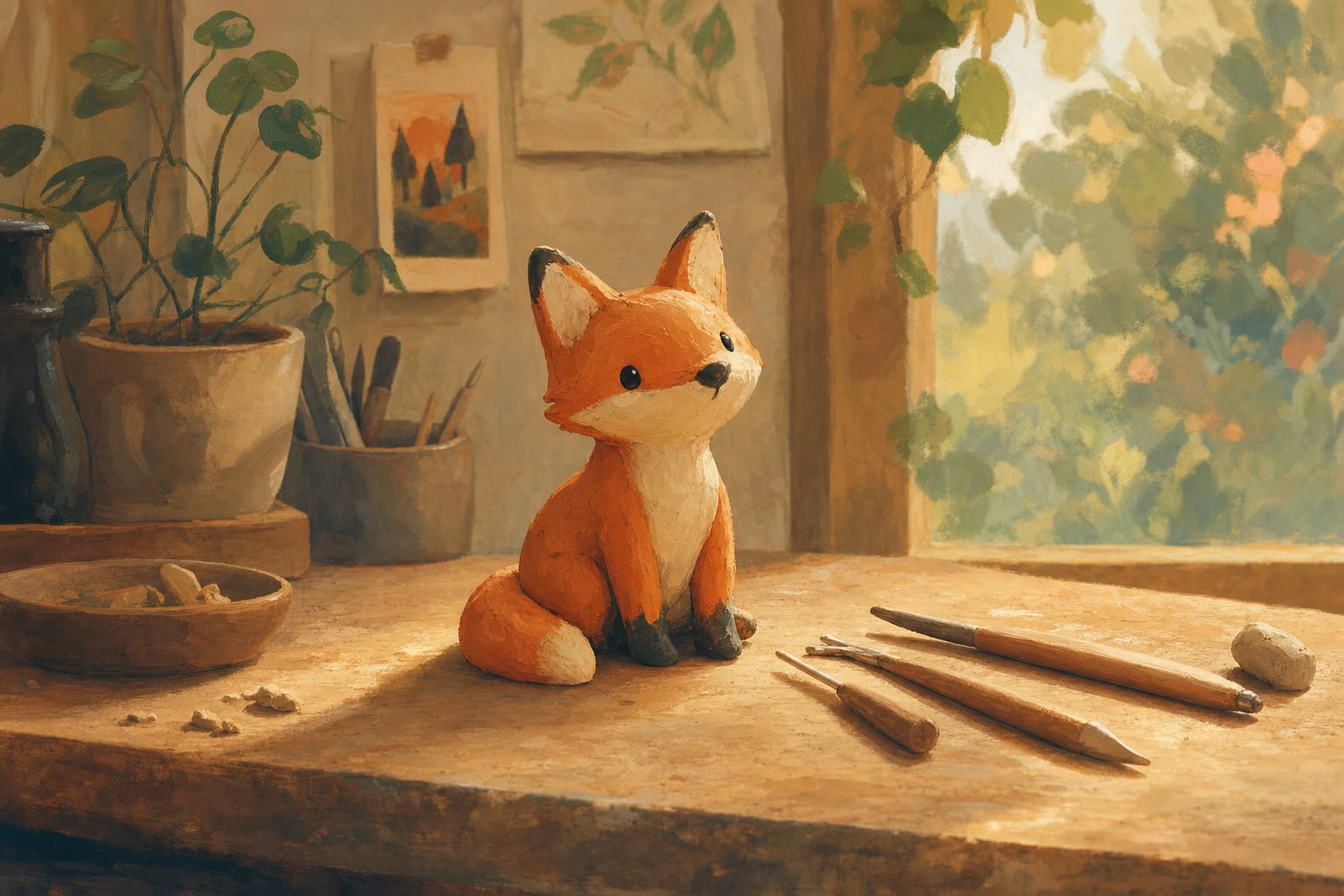
Clay pushes back. Press a thumb into it and it resists, then keeps the dent whether you wanted one there or not. I grew up working in clay, sculpture, paint, and illustration, so I had years of that pushback in my hands before I trained in 3D animation at Pratt Institute. I think the order mattered. Most of what I trust in my own 3D work came from a material with no undo button.
A top-heavy clay figure falls over. Nobody has to explain why. You build a character with a big head on thin legs, you let go, and the table tells you the truth. So you start thinking about where the mass sits and what’s holding it up. Often the answer is an armature, the wire skeleton inside a sculpture that carries the load the clay can’t. It’s the same hidden skeleton that lets a claymation puppet hold a pose from one frame to the next.
Software will let a character stand in a pose no body could hold. Nothing falls over in a viewport. That freedom is useful, and it’s also how you end up with characters that seem to hover a little above the floor. When I pose a character in 3D, I still ask the clay question. If this were sitting on my table, would it stand? Which way would it tip? If the weight over the feet doesn’t make sense in a still pose, polishing the motion later won’t make it feel grounded.
A silhouette is the outline of a character filled in solid, with no detail inside. If you can still tell who it is and what they’re doing, the pose reads. It’s one of the first tests an animator learns, and it’s usually taught from the camera’s point of view.
Clay taught it to me differently, because a sculpture has no camera. You turn it in your hands or walk around it, and every few degrees there’s a new outline that either holds together or doesn’t. A figure can look great from the front and turn into a lump at a three-quarter angle. With clay you find that out early, because your hands never stop rotating the thing.
In 3D it’s easy to fall in love with one angle. You model from the front, check the side, and assume the space between them sorted itself out. So I orbit constantly, which just means swinging the view around the model, and I’ll often switch off the lighting so the character becomes a flat shape and I can judge the outline alone. That habit is all over my 3D character work. I want each figure to hold up from all the way around, the way a sculpture has to.
Clay punishes indecision. Keep fussing with one area and it gets overworked. It dries, it cracks, and the surface goes muddy. At some point you have to decide what the shape is and leave it alone.
Digital tools offer the opposite. Everything is reversible, so nothing ever has to be decided. I can nudge a form forever, and what I get for it is usually a soft, noncommittal character that’s a little bit of everything. So I borrow the clay rule. During the blockout, the early stage where a character is only rough, simple forms, I try to make the big decisions quickly and live with them for a while. Is the body a pear or a brick? Is the head too big on purpose? A clear choice I might change later is worth more to me than a careful average of every option.
Clay also enforces an order of work. You can’t sculpt eyelids on a head that doesn’t exist yet. You start with the largest masses, get the proportions and the gesture right, and work your way down to the small stuff. A screen has no such manners. It will happily let you zoom in and carve pores into a face whose skull is the wrong shape. I stay zoomed out longer than feels comfortable. If the big forms are wrong, the detail is decoration on a mistake.
Handmade things are never perfectly symmetrical. One ear sits higher than the other. A surface keeps the mark of the tool that shaped it. In clay those marks are evidence that a person was there, and I think they’re a big part of why handmade characters feel warm.
3D starts from the other end. The default is perfect: mirrored halves, smooth surfaces, mathematically even curves. To my eye, perfect tends to look lifeless, so a lot of my time in 3D goes to putting the imperfection back on purpose. I break the symmetry once the main forms are settled. I let a line wobble. I tilt something that could have been straight. I want characters that feel made, and clay showed me what made looks like.
If you’re a student, my suggestion is simple: spend some time with real clay. It doesn’t have to be good clay, and what you make doesn’t have to be good either. Build a small figure and try to get it to stand. Turn it in your hands and study the outline from every side. Notice the moment you have to stop fiddling and commit. I think an afternoon of that teaches your hands things that are slow to arrive through a mouse or a stylus.
None of this is an argument against software. I trained in 3D at Pratt, I taught myself 2D animation, and I sculpt digitally in ZBrush, which for me is the closest a screen has come to pushing real material around. I like these tools a lot. They’re still the means. The clay habits are what I carry into them: check the weight, walk around the shape, make a decision, leave a thumbprint. The tool serves the story, and whichever one I pick up next, those habits come along.
If you’re curious about the rest, my biography has more about the mediums I work in. And if there’s a lump of clay within reach right now, go make something lopsided.

Emily Sarah Leeds is a writer and creative enthusiast at Emily Art, where she shares insights on art, creativity, design, and artistic expression. With a passion for exploring visual storytelling and creative techniques, Emily creates informative content that helps readers discover inspiration, develop their artistic skills, and stay connected with the evolving world of art.